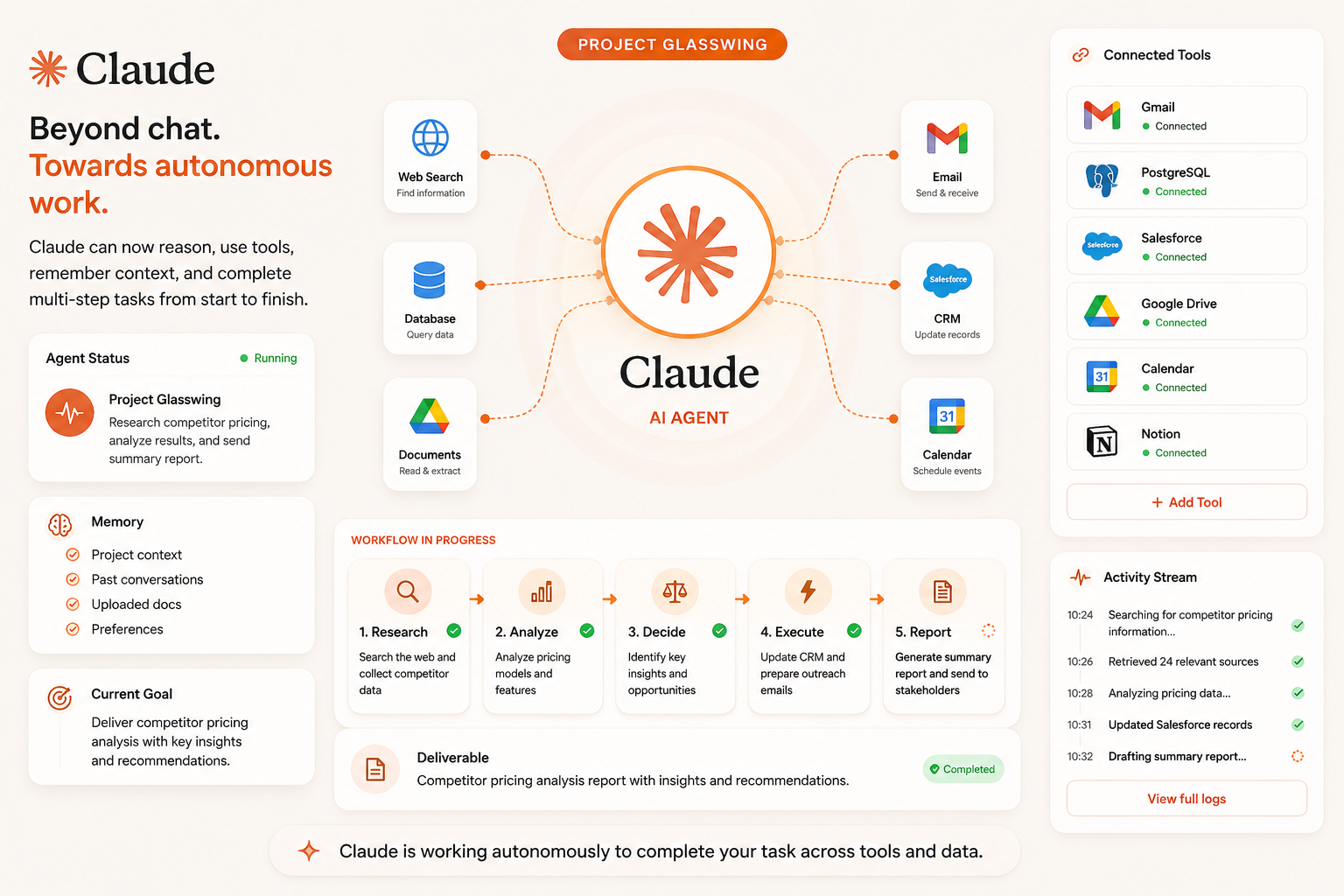
Anthropic has announced an expansion of Project Glasswing, its program designed to push Claude beyond single-turn question-answering toward sustained, multi-step autonomous work. The practical upshot: Claude is being positioned more explicitly as an agent that can operate across longer task horizons, not just a chatbot that responds and waits.
The project focuses on giving Claude more reliable access to tools, memory, and structured workflows — the infrastructure layer that separates a useful demo from a production-grade AI worker. For builders already using Claude via the API, this signals that Anthropic is investing seriously in the agentic use cases many teams are already attempting to hack together themselves.

Why it matters: most real business workflows aren't single prompts. They involve gathering information, making decisions across multiple steps, and taking actions with real consequences. Glasswing is Anthropic's acknowledgment that the competitive frontier has moved there, and that Claude needs first-class support for those patterns rather than bolted-on workarounds.
For teams building on Claude today, the expansion is worth tracking closely. Improvements to tool use reliability, context handling, and task persistence directly reduce the engineering overhead required to build dependable agentic pipelines. Less custom scaffolding means faster iteration and fewer failure modes to debug.
The Hacker News discussion (194 comments, 151 points) reflects genuine builder interest — and healthy skepticism about how well long-horizon autonomy actually holds up in production. That tension between capability claims and real-world reliability is exactly the right thing to stress-test as you evaluate whether Glasswing-era Claude fits your stack.